Tools
The historical record establishes a Smith-era tank and an overflow-water provision in recorded deeds. It does not establish the source or legal character of the water.
What the records establish#
The historical deed record identifies an overflow-water provision from a tank north of the conveyed land. A later 1978 deed identifies that earlier provision. These are documentary facts about the wording of historical instruments. [1] [2]
- Verified physical reference
- Smith-era tank named in the 1959 deed.
- Verified deed provision
- Use of overflow water, as stated in the instrument.
- Not established
- Water source, watercourse, watershed, or legal character.
1959 grant deed#
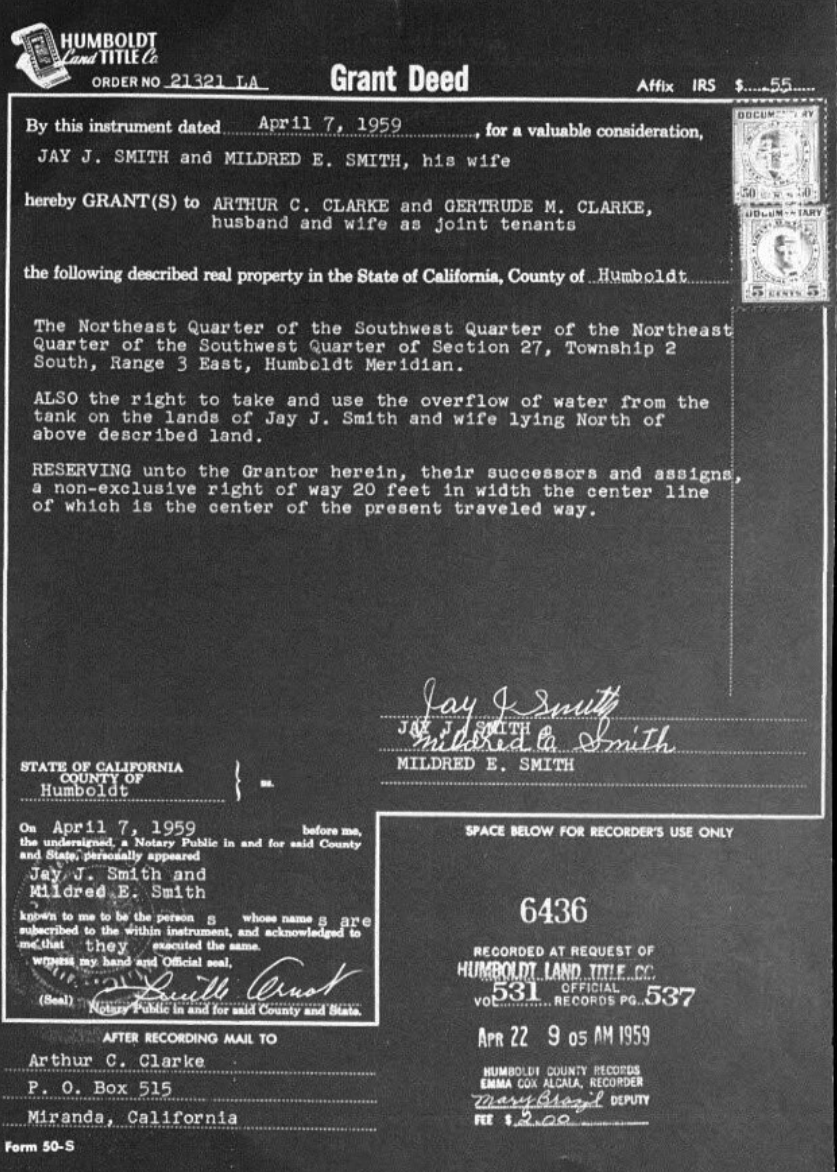
Smith-to-Clarke grant deed#
Record excerpt: “right to take and use overflow water from a tank.”
What the record shows: the stated historical overflow-water provision and a separate traveled-way reservation.
1978 grant deed#
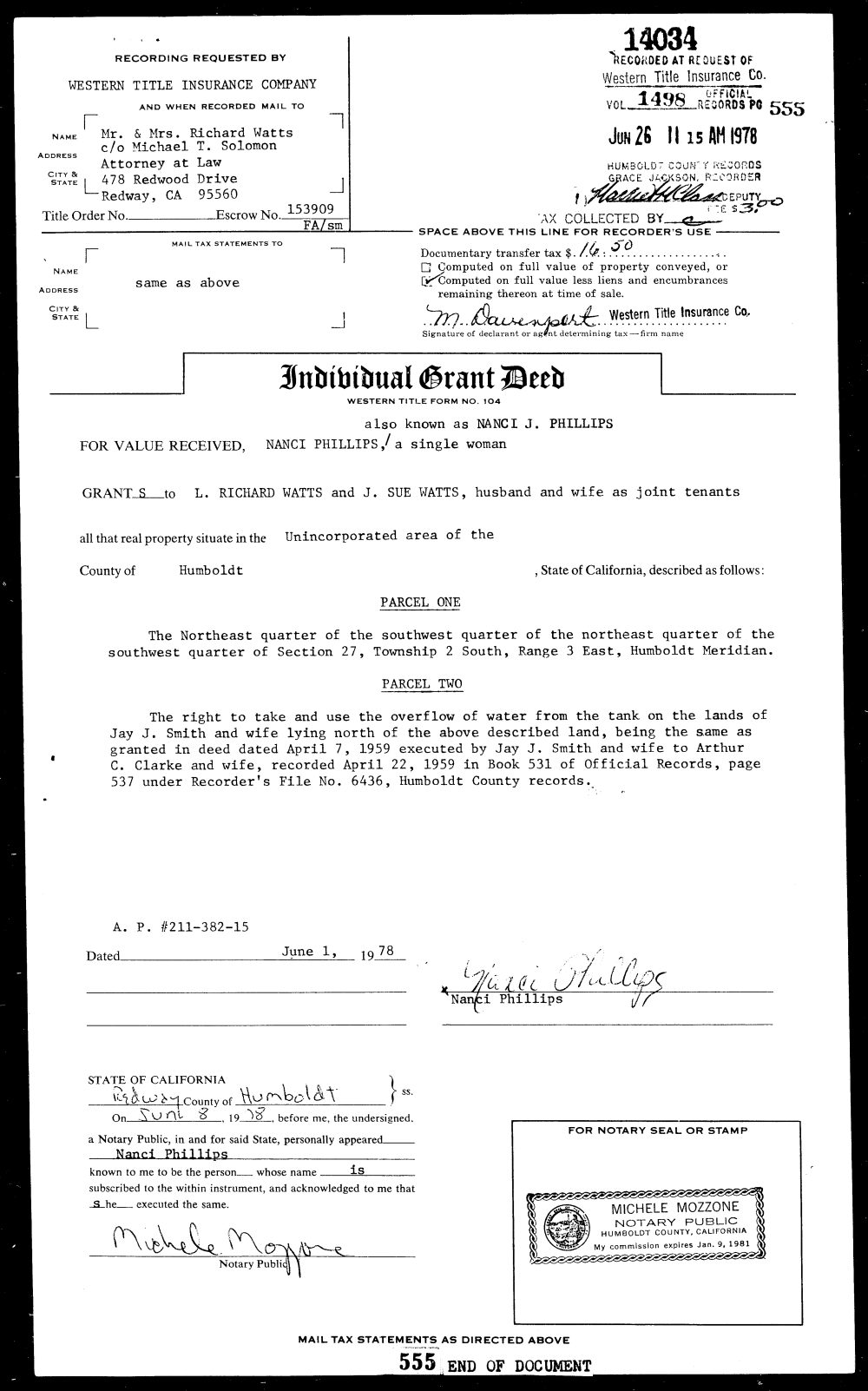
1978 grant deed#
What the record shows: a later historical instrument that identifies the earlier 1959 overflow-water provision.
What remains unresolved#
The deeds do not identify the tank’s original source, a spring, a natural watercourse, a point of diversion, a watershed, or the legal character of the water. Nothing in these records proves that historical Smith water use was riparian. Any future page should preserve this distinction between a recorded historical provision and questions requiring further primary evidence.
Reading the two water-history documents together#
The two deeds provide a small, identifiable documentary sequence. Begin with the 1959 record page, which distinguishes the instrument date of 7 April from the recording date of 22 April. Then compare the 1978 record page, dated 1 June and recorded 26 June. Their Official Records references are 531/537 and 1498/555 respectively.
A physical reference and a recorded provision#
The tank is a physical feature named in the historical wording. The overflow-water provision is part of the instrument. Neither is a complete account of the water system that may have supplied the tank. Keeping those subjects distinct makes it possible to summarize what is documented without inventing a spring, pipeline route, diversion point, or modern operating arrangement.
Later reference to an earlier document#
The 1978 instrument identifies the earlier provision. That gives a reason to read the records together and to retain both recording references in a research note. It does not supply every intervening document or establish that an earlier physical condition continued unchanged. The chronology is a guide to the documents, rather than a complete present title history.
The separate traveled-way wording#
The 1959 deed also contains a traveled-way reservation. The library treats that as a separate subject from the tank-overflow reference. See the road-history discussion for its documentary context. The presence of both subjects in one instrument does not make a water-history summary a road-status determination.
Research method and related sources#
Read the full scans before quoting a passage. Record the document's date, book and page, and the distinction between the original wording and your explanatory note. The public source register groups the deeds with the other recorded material so that a reader can trace the citation back to the same document.
Geographic orientation comes from the Jay Smith Road overview and the Humboldt Meridian survey framework. These contextual pages do not locate a present tank or water source. The map guide likewise distinguishes historical map evidence from a current infrastructure map.
Separate environmental publications describe the State Parks containment project and Forest Service research. They should not be used as evidence for the source or character of water in the historical deeds. The environmental-history article keeps those records in their own context.
The unresolved origin of the tank's water is a useful, specific research question. Until further primary material identifies it, this library retains the limited tank-and-overflow account established by the two deeds.